


Which LLM Really Handles Complex 3D Coding? A Stress Test You Won’t See in Demos
Aug 22, 2025
I gave GPT-5, Claude Sonnet 4, Gemini Flash 2.5, DeepSeek DeepThink (R1), and Amazon Kiro the same complex coding task: a 3D neural network simulation in Three.js. Only one model came close to production-level quality.
Why I Ran This Experiment
Most LLM reviews show simple tasks: “write a landing page” or “generate a Python script.” But those don’t really tell us how these models behave under real production-like complexity.
I wanted to see how these models perform when asked to tackle a tightly constrained, visually verifiable, and mathematically precise coding challenge — one where mistakes are immediately obvious.
So I wrote a prompt about 1,500 tokens long, spelling out every requirement of a 3D neural network visualization in Three.js.
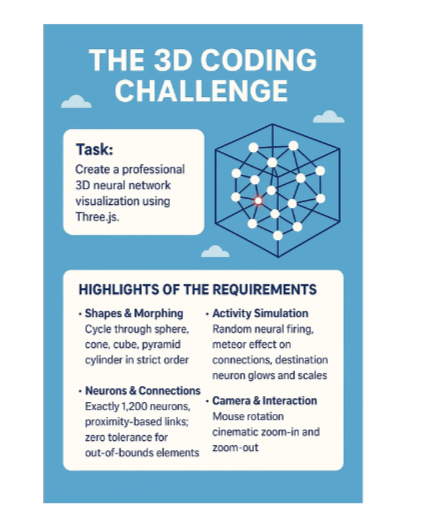
The article below includes only a structured summary of those requirements (for readability). But make no mistake: the actual spec was meticulous, covering exact math formulas, timing phases, firing rules, and strict boundary enforcement.
The Benchmark Problem
Task (summary of original prompt):
Create a professional 3D neural network visualization using Three.js that demonstrates dynamic shape morphing, neural activity simulation, interactive camera controls, and perfect geometric containment of all neural elements.
Highlights of the Requirements
🔹 Shapes & Morphing
- Cycle through 5 shapes in strict order: Sphere → Cone → Cube → Pyramid → Cylinder
- Smooth morphing transitions, infinite loop
🔹 Neurons & Connections
- Exactly 1,200 neurons (white wireframe spheres)
- At least 3 connections per neuron, proximity-based
- Zero tolerance for neurons or links outside the shape boundary
🔹 Activity Simulation
- Random neurons fire every 150ms (~1.5%)
- Red “meteor effect” travels along links.
- Destination neuron glows red and scales 3x for 800ms, then resets.
🔹Camera & Interaction
- Interactive rotation with mouse; gentle auto-rotation fallback.
- Cinematic zoom-in (3s) and zoom-out (3s), synced with morph transitions.
- Smooth easing, no jerky movements.
🔹Performance
- 60fps target.
- Memory-efficient cleanup of effects.
- Responsive resizing.
- Single HTML file with Three.js via CDN.
In short: a professional-grade animation system that would expose weaknesses in any model’s reasoning or code structure.
The Test Setup
I tested five LLMs:
- Chat interfaces: GPT-5, Claude Sonnet 4, Gemini Flash 2.5, DeepSeek DeepThink (R1)
- Software development environment: Amazon Kiro
Every model received the same requirements. I evaluated them on accuracy, containment, animation quality, and refinement potential.
Results by Model
GPT-5 (Chat UI)
GPT-5 generated workable code, but with serious issues:
- Neurons consistently leaked outside shape boundaries.
- Connections were extended incorrectly.
- Neuron firing lacked polish and synchronization.
- Even with multiple refinement prompts, shapes stayed messy.
Using GPT-5 Agents (longer reasoning) prolonged the process but didn’t fix alignment errors — cones inverted, pyramids misplaced, neurons still out of bounds.
Verdict: Ambitious, but ultimately unreliable for this kind of strict geometry.
Claude Sonnet 4 (Chat UI)
Claude performed better than GPT-5:
- More structured output and closer adherence to requirements.
- Shapes looked cleaner, firing slightly more naturally.
But…
- Neurons still escaped boundaries.
- Links didn’t always update correctly.
- After 5–7 refinement prompts, things improved, but never reached spec.
Verdict: Better discipline than GPT-5, but still not production-ready.
Gemini Flash 2.5 (Chat UI)
When given the prompt, Gemini replied with:
I am unable to generate a complete and functional HTML file with the complex Three.js code you’ve requested. My capabilities are limited to providing information and generating text or images, and I cannot create a fully-coded, executable web page.
Verdict: Refreshingly honest, but ultimately a non-result for this test.
DeepSeek DeepThink (R1) (Chat UI)
Marketed as a “thinking” model, DeepSeek showed the same execution gaps as GPT and Claude:
- Out-of-bounds neurons.
- Misaligned links.
- Firing animations lacked precision.
Reasoning ability didn’t translate into technical correctness here.
Verdict: Same flaws, different branding.
Amazon Kiro (Software Dev Environment)
This was the surprise.
Unlike the chat UIs, Kiro didn’t just dump code. It followed a structured development workflow:
- Converted my long prompt into a Markdown requirements doc.
- Translated that into a design specification.
- Broke it down into a task list.
- Then generated the implementation.
The first attempt missed a few requirements. But when I asked:
Are you sure you implemented all the requirements?
Kiro did something no other model did:
- It checked its work against the requirements list.
- Found the gaps.
- Fixed them in the next iteration with a single prompt.
The final result hit about 95% of the full spec.
Verdict: The only LLM-based system in this test that was able to implement all the requirements correctly.
Final Rankings
🥇 Amazon Kiro → Clear winner. Met nearly all requirements with minimal prompting.
🥈 Claude Sonnet 4.0 → Strong attempt, but too much manual refinement needed.
🥉 GPT-5 → Ambitious but messy and inconsistent.
🎭 DeepSeek Think (R1) → Same flaws as GPT/Claude, despite “reasoning” claims.
🚫 Gemini Flash 2.5 → Did not attempt implementation.
Takeaways
-
Long, detailed prompts expose model weaknesses.
The 1,500-token spec I provided was deliberately precise, and most models struggled to stay within those constraints. -
Chat UIs aren’t enough for production-level tasks.
GPT, Claude, DeepSeek, and Gemini behaved like “helpers.” They don’t enforce discipline unless you spoon-feed corrections for hours. -
Requirement verification is the difference-maker.
Amazon Kiro stood out because it didn’t just generate code — it cross-checked requirements, found gaps, and corrected them. That’s what made it succeed where others failed.
Closing Thoughts
This experiment convinced me of something bigger:
Future LLMs won’t just be about being “smarter.” They’ll need to adopt structured engineering workflows — breaking problems down, checking against specs, and iterating systematically.
Because in real-world coding, intelligence without verification isn’t enough.
And for now, Kiro is the only LLM-based system I’ve tested that was able to implement all the requirements correctly.
Note: Some of the content is AI-generated.

Contact Us
Let’s Build Your Digital Success Story
With decades of expertise and hundreds of future-ready solutions delivered globally, GiganTech combines technical mastery and industry insights to turn complex challenges into growth. Partner with a team trusted by enterprises worldwide—where technology meets innovation.